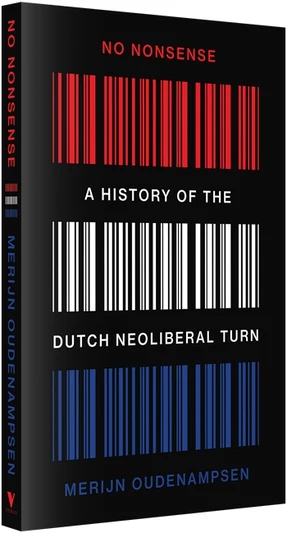
Here an excerpt from the introduction of No Nonsense: A History of the Dutch Neoliberal Turn, out now with Verso Books.
‘Holland isn’t a country, it’s a business at best,’ Michel Houellebecq writes in his bleak 2019 novel Serotonin.[1] Neither do the inhabitants, styled as ‘a race of opportunist polyglot tradespeople’, curry much favor with the infamous French author. Of course, cultural tropes of the Dutch as stingy capitalists are as old as the country itself, and date at least as far back as the 16th century. Jean-Jacques Rousseau once wrote that ‘in Holland, it is said that people demand payment for telling the time or giving directions. A people that thus makes the simplest human obligations into a commodity, has to be very despicable indeed.’[2] At one occasion, the American diplomat and founding father Benjamin Franklin suggested that the Dutch Republic was ‘no longer a nation but a great shop’, with ‘no other principles or sentiments but those of a shopkeeper’.[3]
In more modern times however, the reputation of the Netherlands as a frugal nation of hard-nosed businessmen is a rather recent acquisition. In the 1960s and 1970s, Dutch politicians of various political persuasions built one of Europe’s most generous welfare states, with high wages, a large social housing stock and high taxation levels. In the late seventies, the Financial Times observed that the Dutch had succeeded in establishing ‘one of the world’s most prosperous and enlightened welfare states, with minimum wages higher than in any other industrial society’.[4] Not much later, The Economist noted sardonically that ‘if somewhere must be found to ride out the recession, Holland must be the comfiest place to choose’.[5]
Much has changed since then. Of all OECD countries, the Netherlands has been the country that has retrenched its welfare state the most.[6] It sold large parts of its social housing stock, became the European leader in flexible employment and acquired a reputation as a global tax haven.[7] The share of national income allocated to wages decreased from its historic peak of almost 81% in 1980, to a record low of 69% in 2023. Meanwhile, a longstanding privatization drive has touched everything from the postal service to energy and transportation, from youth and elderly care to kindergarten facilities, the latter now largely owned by private equity.[8] The transformation has extended itself to the political realm. In the last decade, the neoliberal pro-business party VVD (People’s Party for Freedom and Democracy) grew out to become the country’s largest political force. Gradually, the Netherlands converted into an economically liberal country. Of course it is still far from a free market utopia. By international standards, the Netherlands continues to have a low level of income inequality and a relatively generous welfare state. But it has undergone a significant neoliberal transformation.
On the European stage, the Netherlands has made a name for itself as Europe’s staunchest advocate of austerity and structural reform. It was no coincidence that Jeroen Dijsselbloem, the Dutch social democrat finance minister, came to embody the European austerity drive in a dramatic clash with his Greek counterpart Yannis Varoufakis. In marked contrast to the earlier commentaries from the 1970s, the Financial Times and The Economist now depicted the Netherlands as a ‘prosperous Calvinist country’, ‘committed to austerity’, and ‘a famously thrifty people’ with ‘Calvinist attitudes’.[9] As if a penchant for belt-tightening was somehow an engrained quality of the Dutch national character, rather than a newfound political imperative.
How has this change occurred? Who were the main actors and ideas behind this transformation? This book traces the historical roots of this political transformation back to the 1980s, when Dutch politics underwent a neoliberal turn. The Netherlands, of course, wasn’t the only country to experience a political transformation of this kind. The iconic example is the rise of Margaret Thatcher and Ronald Reagan, who pushed through a free market revolution amid a fierce ‘battle of ideas’ with Keynesian policy elites and a polarizing confrontation with the trade unions. In the past decades, a large literature has emerged on the rise of neoliberalism in a wide range of countries.[10] The Netherlands though, is still a relatively blank space on the map.[11] The country has long been considered an exception to the rule.
The Dutch, it has long been argued, pursued market-based reform in a more reasonable and pragmatic fashion, through consensual politics and corporatist compromise. The political scientist Peter Katzenstein was the first to make this argument. In his 1986 classic Small States in World Markets, he discussed economic policy in small Western European countries. Katzenstein contended that small states with open economies were vulnerable to shocks but could not enact protectionist measures, nor could they push through policies in a polarized and authoritarian manner.[12] Instead, policymakers relied on a corporatist strategy: enlisting the co-operation of trade unions and business associations to secure broad support for market-oriented reforms. According to Katzenstein, this helped smoothen the process of economic adjustment. Published in the midst of Ronald Reagan’s presidency, Small States was as much an exercise in comparative political economy as a criticism of the polarized nature of American politics.
Roughly ten years later, Dutch social scientists Jelle Visser and Anton Hemerijck drove home Katzenstein’s point in their landmark study ‘A Dutch Miracle’.[13] It appeared at a fortuitus moment: the Dutch economy was experiencing a strong economic recovery in the mid-1990s, after a decade of austerity and market-based reform. The Dutch economic model began to acquire international fame. The Wall Street Journal praised the Netherlands for being the only European country to cut back its welfare state, while central bankers Hans Tietmeyer and Jean Claude Trichet held up the Dutch reforms as an example for Germany and France.[14] Not to be outdone, US president Bill Clinton lauded the Dutch economic model as an inspiration for the Third Way.[15] ‘Dutch take Third Way to prosperity’, The New York Times wrote, upholding the Dutch approach as a model for Europe.[16]
In their book, Visser and Hemerijck argued that the Dutch consensual approach was a superior alternative to the polarizing politics of Reagan and Thatcher. Central to their account was the ‘Wassenaar Accord’ from 1982, in which Dutch trade unions and employers agreed to moderate private sector wages to combat the economic crisis. Visser and Hemerijck depicted this agreement as the return of corporatist consensus in the Netherlands, providing support for a series of austerity measures and supply-side reforms. ‘A broad consensus over central policy goals’, they noted, rendered ‘policy elites sufficiently autonomous from partisan pressures’, ‘to formulate and implement policies based upon efficiency, expertise, and professional rationality rather than political expediency’.[17] They stressed in particular the role of the Dutch trade unions, and ‘the possibility that under specific institutional preconditions, comprehensive interest groups might have learned from failure and feel themselves under a sense of urgency “to make things better” and support reforms against the short-term interests of some of their constituency.’[18]
This focus on consensus and pragmatism as a driver of Dutch market-based reform quickly became the scholarly norm.[19] ‘A remarkable aspect of the rather radical change in government policy is that it was shared by all major parties involved,’ wrote Jan Luiten van Zanden in his standard work on Dutch economic history. ‘In the early 1980s, a new consensus emerged in Dutch politics’.[20] Erik Jones declared that policy changes in the Netherlands were ‘more practical than ideological’: ‘neo-liberal outcomes were accepted, not because they were neo-liberal but because they were necessary’.[21]
While internationally, the neoliberal turn developed into the dominant narrative of the changes in economic policy of the 1980s and 1990s, the Dutch success story of the ‘polder model’ buried that of neoliberalism. Naturally, this story of consensus and pragmatism has always been somewhat of a self-congratulatory narrative: while politicians elsewhere were engaged in heated ideological brawls, the Dutch resolved things in a calm and professional manner. Critics have shown that the degree of consensus has been overstated, while the role of corporatist institutions was surprisingly inconsequential for most of the 1980’s. The Canadian political scientist Steven Wolinetz was among the first of these critics. After doing a series of expert interviews, he argued that the Dutch case did not really fit Katzenstein’s thesis of smooth adjustment. The market-based shift, Wolinetz noted, did not originate in the ‘Wassenaar Accord’ or in corporatist institutions. Instead, he pointed to ‘the relatively autonomous role of the government in determining policy’. The Dutch government decided to consciously ‘circumvent corporatist structures in order to orchestrate a response to economic change’, while the Dutch trade unions were allowed ‘scant influence on government policy’.[22] In the decades that followed, Wolinetz’s critique was taken up by a series of Dutch scholars and politicians, who argued that Dutch labor relations could better be described in terms of ‘dominance’ and ‘acquiescence’, rather than consensus.[23]
Among these politicians was Bert de Vries, the former Christian democratic Minister of Social Affairs. He complained in his political memoirs that the idea of the polder model had taken on ‘mythological proportions’.[24] A key player in the clashes of the time, De Vries stressed that the common notion that ‘Dutch economic restructuring took place in great corporatist harmony’ was ‘decidedly wrong’.[25] Of course, it was true that the Dutch government didn’t wage war on the trade unions like Thatcher and Reagan did. Still, the Dutch trade unions were strongly opposed to the 1980s market-based reforms, and politely ignored by politicians and policymakers as a result. The Social and Economic Council, the major corporatist public policymaking body, remained divided over the reforms of the 1980s and was largely bypassed and ignored.[26]
This book builds on these critiques and aims to deconstruct the consensual myths that have been erected around Dutch economic policy. Dutch market-based reforms weren’t simply the result of ‘professional rationality’ and objective expertise. That was, as we will see, the official government line. But on a deeper level, the policy shift had an obvious ideological character. When we consider the ideas behind the reforms, we find very similar inspirations as in the Anglo-American context. Senior Dutch economic policy makers referred to neoliberal economists such as Milton Friedman, James Buchanan, Martin Feldstein, Robert Lucas and Robert Barro to plead for more market, less government. In other words, the Netherlands was far from immune from the wave of free market ideology sweeping the globe. The scholarly use of the Dutch case as a contrast to the Anglo-American trajectory seems to have obscured the overarching parallels.
No-nonsense
It was the Christian democrat Ruud Lubbers, Dutch prime minister from 1982 till 1994, who forcefully broke with Keynesian recipes and embarked on a neoliberal agenda of austerity, tight monetary policy, labor market liberalization, deregulation and privatization. On the occasion of an official visit to Washington, Time Magazine portrayed Lubbers glowingly as ‘Ruud Shock’, who had ‘transformed the Netherlands from one of Western Europe’s freest-spending welfare states into its leading belt tightener’.[27] The Time Magazine article featured a reverential quip by Margaret Thatcher on an earlier state visit to the Netherlands: ‘Mr. Lubbers, are you really intending to cut the salaries of your public employees by more than 3%? That’s a disaster. I am supposed to be the toughest in Europe. You are going to ruin my reputation as the Iron Lady.’
The 1982 government comprised of Christian democrats (CDA) and right-wing liberals (VVD) enacted far-reaching austerity measures and cut public sector wages and unemployment benefits. As a leading Dutch economist wrote, it was ‘the first government in the post-war period to make a wholesale break with the Keynesian ideas that have long been such an important influence on economic policy’.[28]
The Lubbers government certainly did not conceal its pro-business leanings. In keeping with the spirit of the opening Houellebecq quote, Ruud Lubbers and his cabinet literally referred to the Netherlands as a business enterprise. Many of the ministers had been recruited from the Dutch business elite and proudly presented themselves to the public as hardheaded ‘managers’ in politics, charged with downsizing an ailing company. They proclaimed they were running the ‘BV Nederland’ or ‘the Netherlands Inc.’ The metaphor signaled that the restoration of business profitability had become the leading political priority. What was good for Dutch business was good for the nation. After a decade defined by leftist social movements and trade union militancy, business had returned to the heart of Dutch political life.
In sharp contrast however, to the grand ideological rhetoric of Thatcher and Reagan, the Dutch Prime Minister Ruud Lubbers carefully depoliticized the reforms as ‘no-nonsense policies’, presenting them as an objective necessity decreed by objective policy elites. Lubbers had obvious reasons for doing so. The Dutch Christian democrats, the dominant force in Dutch politics for most of the postwar period, had nothing to gain by using polarizing language. As a centrist party, it had to accommodate its center-left flank and trade union wing to push reforms through parliament. For this reason, it was essential to present the policy shift in a depoliticized manner. Hans van der Voet, head of communications during the Lubbers cabinets, made this point explicitly:
If you take away three per cent of people’s wages, it is better to refrain from grand narratives. Then you will certainly fall flat on your face. You can proselytize on television with a blackboard on your side, but that does not work. All the viewers can count for themselves. Lubbers understands this. This is a frugal policy, and it is better to present it in a business-like and depoliticized manner. It will seem somewhat corporate, but you shouldn’t loudly proclaim that it is your holy mission to fire so many teachers and care workers.[29]
Depoliticization, it is argued, involves displacing a contentious issue from the political sphere, to ‘quasi-public bodies and to officials who can present them as purely technical matters’.[30] This was certainly a central part of the strategy. The first Lubbers cabinet outsourced the initiative to senior officials at the Ministries of Finance and Economic Affairs. As the political parties were internally divided over economic policy, the task of hammering out a neoliberal supply-side policy was left to civil servants. ‘The bureaucrats have come up with the solutions, and then it’s our turn to implement them’, the Christian democratic Minister of Welfare, Public Health and Culture explained.[31] It was Max Weber’s classic theory of state bureaucracy turned on its head.[32] The result was an exceptionally technocratic and ideologically hushed neoliberal turn, in which the senior civil servants at the ministries of Finance and Economic Affairs played an outsized role.
In a more general sense, depoliticization involves the framing of a politically contentious issue in terms of fate and necessity.[33] This is also something that has clung to the Dutch reforms. In the 1980s and early 1990s, the ‘no-nonsense’ policies and austerity measures were awash in controversy, their effectivity often put in doubt. In 1988, the OECD observed in its Economic Outlook that the Netherlands had been one of the worst performing OECD-countries in the 1980s. Economic growth was structurally 1% lower and unemployment 5% higher than the OECD average. Public debt had risen steeply from 50,6% of GDP in 1980 to 72,6% of GDP in 1990, while public and private investments lagged behind.[34] In fact, the Netherlands had experienced the lowest growth of GDP per capita of all OECD countries from 1980 till 1993.[35] In this common indicator for a country’s wealth, the Dutch had fallen behind Germany, France, the United Kingdom, Belgium and Italy. Yes, business profitability had been restored, wages had been moderated and public spending was curtailed, but no-one celebrated the austerity of the 1980s as a big success. The larger picture was one of worrying stagnation. Deep-seated conflicts about the depth of austerity and market reform dominated the political debate. Social democrats and trade unions alike bitterly denounced the ‘neo-liberal approach’ of the right-wing government.[36] In exchange, they were sidelined from the policymaking process and reduced to organizing a series of fruitless mass protests.
It was a polarized standoff, but that changed in 1989, when Lubbers changed tack and formed a center-left government with the social democrats. The ideological tide was changing. In fits and starts, a new compromise emerged between neoliberal reform and corporatist social democracy, a Dutch Third Way. In the mid-1990s, buoyed by a great rise in female parttime employment and a credit-fueled housing market boom, the Dutch economy experienced an impressive recovery. It cleared the way for a new, shared understanding of the recent past. The ‘no-nonsense’ austerity policies of the 1980s and wage moderation agreed in the 1982 Wassenaar Accord were now widely celebrated as the root cause of the recovery and achieved the uncontroversial status of a historical necessity. The deep conflicts and ideological divisions over economic policy were soon ignored or forgotten. The Dutch ‘polder model’ became an international cause célèbre, proof of the blessings of consensual politics and a market-minded left.
This revised understanding of the 1980s fundamentally shaped the Dutch perspective on how to respond to an economic crisis. It became the basis for the political belief in expansionary austerity, which defined the Dutch position during the Eurocrisis. ‘It’s not about what Brussels wants,’ the Dutch right-wing liberal prime minster Mark Rutte underlined at a Euro Summit in Brussels in March 2012. ‘I value fiscal discipline because I think it’s important. It’s the lesson of the 1980’s.’[37] In the most important fiscal policy document, the government’s Budget Memorandum of 2010, the 1980s were presented as proof that one could cut one’s way to growth:
‘the Dutch experiences of the 1980s showed that while consolidation can indeed hurt, it can also provide the basis for economic recovery. The government decided to intervene vigorously: industrial subsidies were halted; unemployment benefits lowered; public sector wages cut. With the Wassenaar Accord, the social partners and the government agreed to moderate wages in the private sector. This contributed in subsequent years to a lower inflation and the recovery of Dutch competitiveness.’[38]
Similarly, in a 2011 book on the Eurocrisis, the most influential Dutch economic think tank, the Central Planning Bureau (CPB), held up the Dutch 1980s reforms as an inspiration: ‘Experience teaches that often a large crisis is necessary before far-reaching reforms can be implemented to boost growth. The Netherlands has successfully implemented such a policy in the 1980s and 1990s and is now reaping the benefits. Before that could occur, our country had to bite the bullet.’[39] In other words, the lesson drawn from the 1980s by Dutch policymaking elites was that one should never waste a good crisis.
During the Eurocrisis, subsequent coalition governments led by the right-wing liberal prime minister Mark Rutte implemented an ambitious austerity program of an estimated fifty billion euros in budget cuts and tax increases, which is now widely believed to have deepened the crisis. A coalition of right-wing liberals (VVD) and social democrats (PvdA) that governed from 2012 till 2017 were responsible for the lion’s share of these measures. It included controversial and painful cuts in social security, education and social care. At the end of their term, the social democrats were punished with the single largest electoral defeat in Dutch history, losing 29 of their 38 seats in parliament. Since then, the broader bloc of the Dutch left has dwindled electorally to its lowest score of the entire postwar period.
The legacy of the 1980s however, has also cast its shadow on the political right. The neoliberal pro-business party VVD became the leading political force in a highly fragmented political landscape. After assuming the leadership of the VVD, Mark Rutte expressed his admiration for Friedrich Hayek and stated that The Road to Serfdom was ‘essential reading for liberals’.[40] When prime Minister Mark Rutte presented his first government, he declared in parliament that ‘the Netherlands suffers from administrative obesity, and it’s about time we put the state on a diet. Bureaucracy is a tax on growth. Society itself can do things better if the government steps back.’[41] In public lectures, Rutte presented his policies as a reiteration of the 1980s, a period he remembered glowingly as the first time the state was forced back.
The neoliberal reforms of the 2010s deepened the crisis however, and in his last coalition government, Rutte was forced to change tack and repair some of the damage done to the Dutch public sector. As the longest serving prime minister in Dutch history, Rutte oversaw a period of declining trust in government and elites, and waning support for free market recipes. In 2024, his party VVD tried to win the elections by foregrounding immigration instead. It inadvertently set the stage for a victory of Geert Wilder’s right-wing populist Freedom Party. By that time, Mark Rutte had left Dutch politics to become secretary general for NATO.
[1] Michel Houellebecq, Serotonin (New York: Farrar, Straus and Giroux, 2019), 24.
[2] Rousseau cited in Nelleke Noordervliet, “Een Volk van Nomaden Met Een Rijtjeshuis,” NRC Handelsblad, October 20, 1994.
[3] Benjamin Franklin, The Complete Works of Benjamin Franklin, vol. 7 (G. P. Putnam’s sons, 1888), 283.
[4] The Financial Times, November 1, 1977.
[5] The Economist, January 30, 1982
[6] Christoffer Green-Pedersen, The Politics of Justification: Party Competition and Welfare-State Retrenchment in Denmark and the Netherlands from 1982 to 1998 (Amsterdam: Amsterdam University Press, 2002).
[7] Diederik Stadig, “Ruling the Dutch Tax Haven: How the United States Drove the Rise and Fall of the Ruling Practice of the Netherlands,” Politics of the Low Countries, Online first 2024; Naomi Woltring, “De Marktconforme Verzorgingsstaat 1989-2008” (Utrecht University, 2023), 99–100.
[8] Bart Stellinga, Dertig Jaar Privatisering, Verzelfstandiging En Marktwerking (Amsterdam: Amsterdam University Press, 2012); Mirjam de Rijk, Gekaapt Door Het Kapitaal: Zorg, Onderwijs, Wonen En de Kinderopvang (Amsterdam: Pluim, 2024); Roelof Kuiper, De Terugkeer van Het Algemeen Belang: Privatiseringsverdriet En de Toekomst van Nederland (Van Gennep, 2014).
[9] Matt Steinglass, “Dutch Mood Shifts against Austerity and the EU,” Financial Times, August 8, 2013; The Economist, “Not so Calvinist Anymore,” The Economist, October 3, 2013.
[10] Mark Blyth, Great Transformations: Economic Ideas and Institutional Change in the Twentieth Century (Cambridge, U.K.: Cambridge University Press, 2002); Monica Prasad, The Politics of Free Markets: The Rise of Neoliberal Economic Policies in Britain, France, Germany, and the United States (Chicago: University of Chicago Press, 2006); Quinn Slobodian, Globalists: The End of Empire and the Birth of Neoliberalism (Cambridge, Mass.: Harvard University Press, 2018); Philip Mirowski and Dieter Plehwe, eds., The Road from Mont Pèlerin: The Making of the Neoliberal Thought Collective (Cambridge, Mass.: Harvard University Press, 2009); Angus Burgin, The Great Persuasion: Reinventing Free Markets since the Depression (Cambridge, Mass.: Harvard University Press, 2012); Cornel Ban, Ruling Ideas: How Global Neoliberalism Goes Local (Oxford University Press, 2016); John L. Campbell and Ove K. Pedersen, The Rise of Neoliberalism and Institutional Analysis (Princeton, NJ: Princeton University Press, 2001); Colin Hay, “The Genealogy of Neoliberalism,” in Neoliberalism: National and Regional Experiments with Global Ideas, ed. Ravi K. Roy, Arthur T. Denzau, and Thomas D. Willett (London: Routledge, 2006), 73–92; Hay, Why We Hate Politics; William Davies, The Limits of Neoliberalism: Authority, Sovereignty and the Logic of Competition (Sage, 2016); Vivien A Schmidt, The Futures of European Capitalism (Oxford: Oxford University Press, 2002); Peter Hall, “Policy Paradigms, Social Learning, and the State: The Case of Economic Policymaking in Britain,” Comparative Politics 25, no. 3 (1993): 275–96; Jamie Peck, Constructions of Neoliberal Reason (Oxford: Oxford University Press, 2010).
[11] See for more indirect treatments of Dutch neoliberalism: Jeroen Touwen, Coordination in Transition: The Netherlands and the World Economy, 1950–2010 (Leiden: Brill, 2014); Petrus Willem Zuidhof, “Imagining Markets: The Discursive Politics of Neoliberalism” (PhD, Erasmus Universiteit, 2012); Bastiaan Van Apeldoorn, “A National Case-Study of Embedded Neoliberalism and Its Limits: The Dutch Political Economy and the ‘No’ to the European Constitution,” in Contradictions and Limits of Neoliberal European Governance (Springer, 2009), 211–31. Non-academic books on neoliberalism in the Netherlands, tend to portray it as a foreign ideology, that has entered the Netherlands through a strange process of osmosis. see Hans Achterhuis, De utopie van de vrije markt (Rotterdam: Lemniscaat, 2010); Marc Chavannes, Niemand Regeert (Amsterdam: Nieuw Amsterdam, 2009); Maarten van Rossem, Kapitalisme zonder remmen: opkomst en ondergang van het marktfundamentalisme (Amsterdam: Nieuw Amsterdam, 2011); Marcel van Dam, Niemands land: biografie van een ideaal (Amsterdam: De Bezige Bij, 2009); Gerard Driehuis, De daders en de meelopers: wie is wie in de kredietcrisis (Amsterdam: Balans, 2009); Duco Hellema and Margriet van Lith, Dat Hadden We Nooit Moeten Doen: De PvdA En de Neoliberale Revolutie van de Jaren Negentig (Amsterdam: Prometheus, 2020).
[12] Peter J Katzenstein, Small States in World Markets: Industrial Policy in Europe (Ithaca, N.Y.: Cornell University Press, 1985).
[13] Jelle Visser and Anton Hemerijck, “A Dutch Miracle”: Job Growth, Welfare Reform and Corporatism in the Netherlands, Changing Welfare States (Amsterdam: Amsterdam University Press, 1997).
[14] `The Dutch Exception’, The Wall Street Journal 24 April 1997, 8.
[15] Luchien Karsten, Kees van Veen, and Annelotte van Wulfften Palthe, “What Happened to the Popularity of the Polder Model? Emergence and Disappearance of a Political Fashion,” International Sociology 23, no. 1 (2008): 53.
[16] Marlise Simons, “Dutch Take ‘Third Way’ to Prosperity,” The New York Times, June 16, 1997, 6.
[17] Visser and Hemerijck, “A Dutch Miracle,” 74.
[18] Visser and Hemerijck, 62.
[19] See Anton Hemerijck and Martin Schludi, “Sequences of Policy Failures and Effective Policy Responses,” Welfare and Work in the Open Economy 1 (2000): 125–228; Hans Keman, “Explaining Miracles: Third Ways and Work and Welfare,” West European Politics 26, no. 2 (2003): 115–35; Fritz W Scharpf and Vivien A Schmidt, Welfare and Work in the Open Economy: From Vulnerability to Competitiveness in Comparative Perspective, vol. 1 (Oxford: Oxford University Press, 2000); Vivien A Schmidt, “How, Where and When Does Discourse Matter in Small States’ Welfare State Adjustment?,” New Political Economy 8, no. 1 (2003): 127–46. Other scholars pointed to a party-political consensus on economic policy as key to Dutch welfare state retrenchment. See Frank Hendriks, Polder Politics: The Re-Invention of Consensus Democracy in the Netherlands (Routledge, 2017); Green-Pedersen, The Politics of Justification: Party Competition and Welfare-State Retrenchment in Denmark and the Netherlands from 1982 to 1998; Robert Henry Cox, “The Social Construction of an Imperative: Why Welfare Reform Happened in Denmark and the Netherlands but Not in Germany,” World Politics 53, no. 3 (2001): 463–98.
[20] Jan Luiten Van Zanden, The Economic History of the Netherlands 1914-1995: A Small Open Economy in the “Long” Twentieth Century (London: Routledge, 1998), 170.
[21] Erik Jones, “The ‘Monetarist’ Turn in Belgium and the Netherlands,” in Monetary Union in Crisis: The European Union as a Neo-Liberal Construction, ed. Bernard H. Moss (London: Palgrave Macmillan UK, 2005), 247. See also Erik Jones, Economic Adjustment and Political Transformation in Small States (Oxford: Oxford University Press, 2008).
[22] Steven B Wolinetz, “Socio‐economic Bargaining in the Netherlands: Redefining the Post‐war Policy Coalition,” West European Politics 12, no. 1 (1989): 90, 95. Rudi Andeweg, “From Dutch Disease to Dutch Model? Consensus Government in Practice,” Parliamentary Affairs 53, no. 4 (October 1, 2000): 697–709.
[23] Uwe Becker, “A ‘Dutch Model’: Employment Growth by Corporatist Consensus and Wage Restraint? A Critical Account of an Idyllic View,” New Political Economy 6, no. 1 (2001): 19–43; Jaap Woldendorp, The Polder Model–from Disease to Miracle? Dutch Neo-Corporatism 1965-2000 (Rozenberg Publishers, 2005); Andeweg, “From Dutch Disease to Dutch Model?”; Jaap Woldendorp and Hans Keman, “The Polder Model Reviewed: Dutch Corporatism 1965—2000,” Economic and Industrial Democracy 28, no. 3 (2007): 317–47; Uwe Becker, “An Example of Competitive Corporatism? The Dutch Political Economy 1983–2004 in Critical Examination,” Journal of European Public Policy 12, no. 6 (2005): 1078–1102; Uwe Becker, “‘Miracle’ by Consensus? Consensualism and Dominance in Dutch Employment Development,” Economic and Industrial Democracy 22, no. 4 (2001): 453–83; Wiemer Salverda, “The Dutch Model: Magic in a Flat Landscape?,” in Employment “Miracles”: A Critical Comparison of the Dutch, Scandinavian, Swiss, Australian and Irish Cases versus Germany and the US (Amsterdam: Amsterdam University Press, 2005), 39–64.
[24] Bert De Vries, Ontspoord Kapitalisme: Hoe Het Kapitalisme Ontspoorde En Na de Coronacrisis Hervormd Kan Worden. (Amsterdam: Prometheus, 2020), 238.
[25] Ibid.
[26] Anthonie Knoester, Economische Politiek in Nederland (Leiden: Stenfert Kroese, 1989), 167; Ad Geelhoed, “Making a Difference: De Beleidsagenda En AEP,” Tijdschrift Voor Politieke Economie 24, no. 1 (2002): 60–72; B.J.P. van Bavel, Rogier Overman, and Pieter Webeling, SER 1950-2010: zestig jaar denkwerk voor draagvlak advies economie en samenleving (Amsterdam: Boom, 2010).
[27] Time Magazine, “The Netherlands: Ruud Shock,” Time Magazine, January 23, 1984, 29.
[28] Knoester, Economische Politiek in Nederland, 159.
[29] Cited in Max van Weezel and Joop van Tijn, Inzake Het Kabinet-Lubbers (Amsterdam: Sijthoff, 1986), 254.
[30] Colin Hay, Why We Hate Politics (Cambridge: Polity Press, 2007), 81.
[31] Elco Brinkman cited in Weezel and Tijn, Inzake Het Kabinet-Lubbers, 161.
[32] Max Weber, From Max Weber: Essays in Sociology, trans. Hans H. Gerth (London, 1970).
[33] Hay, Why We Hate Politics, 79.
[34] OECD, Economic Outlook 44 (december 1988).
[35] Eduard Bomhoff, Een Haagse Lente? (Schoonhoven: Academic Service, 1994), 44; Jeroen J. M. Kremers, Inspelen Op Europa: Uitdagingen Voor Het Financieel-Economische Beleid van Nederland (Schoonhoven: Academic Service, 1993), 1.
[36] Wim Kok, “Volledige Werkgelegenheid: Uitdagingen Voor de Jaren Tachtig,” Socialisme & Democratie 45, no. 7/8 (1983): 3–7.
[37] Cited in Coen Teulings, Over de Dijken: Tien Jaar Na Het Uitbreken van de Financiële Crisis (Amsterdam: Prometheus, 2018), 103.
[38] Kamerstukken II, 2010–2011, 32 500, nr. 1, p. 37.
[39] Coen Teulings et al., Europa in Crisis: Het Centraal Planbureau over Schulden En de Toekomst van de Eurozone (Amsterdam: Balans, 2011), 147.
[40] Mark Rutte, ‘Betutteling: Politiek van wantrouwen’, Elsevier Weekblad, 11 August 2007.
[41] Ministerie van Algemene Zaken, “Regeringsverklaring 2010 minister-president Rutte” (Kamerstuk, October 26, 2010).


Leave a comment